A roof can be old without being ready for replacement, while a younger roof may still need attention. If you’re asking “how long does a roof last Ireland?”, the honest answer is that age is only part of the picture.
Lifespan estimates vary because slate, tiles, metal and flat-roof coverings wear in different ways. In Ireland, persistent rain, strong winds and damp conditions can add to the strain, but exposure, workmanship and maintenance matter too. Age alone can’t tell you whether a roof needs monitoring, a repair or a closer inspection.
This guide explains realistic, qualified lifespan expectations by roof type and what can shorten or extend them. You’ll also learn which signs to watch for and when an inspection may help clarify your roof’s condition. The aim is to help you make a sound decision based on what your roof needs, not to rush you into replacement.
Key Takeaways
- The answer to “how long does a roof last Ireland” depends on its material, installation, exposure and upkeep, not age alone.
- Lifespan figures are estimates, not guarantees or replacement deadlines. Compare them with the roof’s actual condition.
- Irish rain and wind can affect roof performance, so workmanship, sound detailing and regular attention all matter.
- Gather roof records, identify the material and note past repairs. Check for visible signs from the ground and don’t climb onto the roof.
- A professional inspection can help clarify whether monitoring or repairs are sensible. An older roof does not automatically need replacing.
How long does a roof last in Ireland? Start with a realistic range
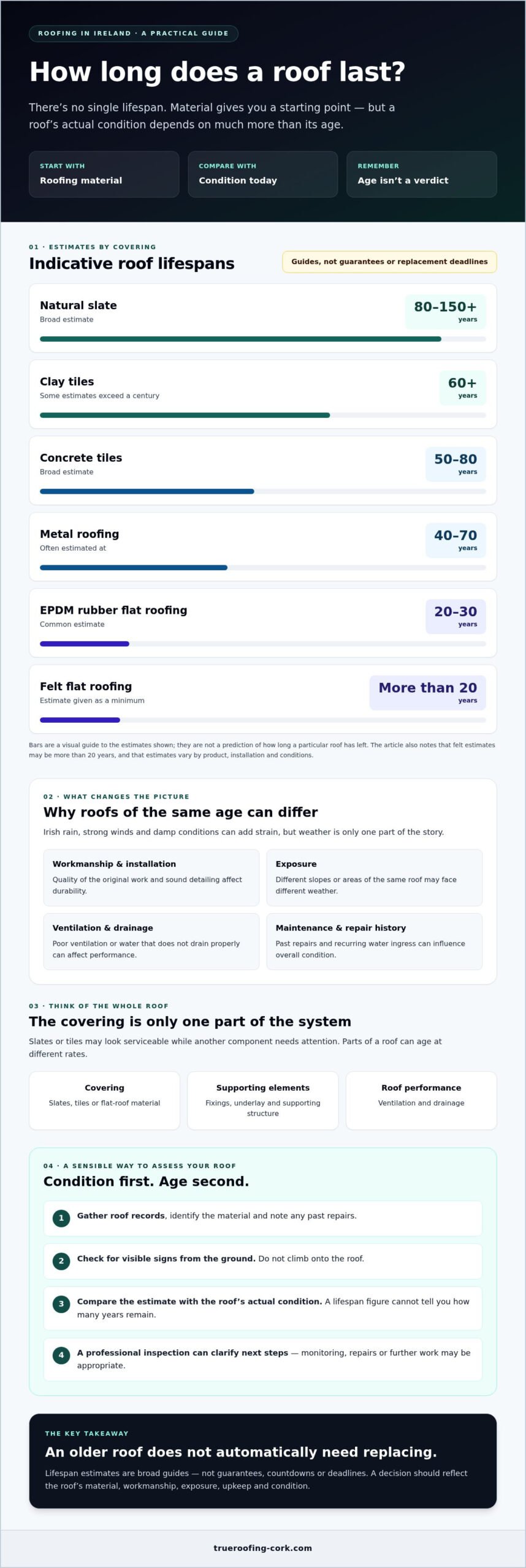
There isn’t one fixed answer to “how long does a roof last Ireland?” It depends on the covering, the quality of installation, exposure to weather and maintenance over time. As broad estimates, natural slate may last around 80 to 150 years or more, concrete tiles around 50 to 80 years, and clay tiles 60 years or longer. Metal roofing is often estimated at 40 to 70 years. Flat-roof coverings vary: felt may last more than 20 years, while EPDM is commonly estimated at 20 to 30 years. These are guides, not guarantees or deadlines for replacement.
Such estimates describe a material’s potential service life in particular conditions. They don’t tell you how many years remain on your roof, and figures can vary by product and installation. For example, an asphalt shingle is a different type of covering from slate or tile, so its expected service life shouldn’t be compared without considering the material and conditions.
What does a roof’s expected lifespan actually mean?
A roof is a system, not just its visible covering. Slates or tiles, fixings, underlay, ventilation, drainage and supporting structure can all age at different rates. The covering may still look serviceable while another component needs attention. Lifespan estimates help set expectations, but they aren’t a promise that every part of the roof will last for the same length of time.
Why can two roofs of the same age differ?
Workmanship, ventilation, drainage and exposure all affect durability. Roof design and repair history matter too. One slope may face harsher weather, while another area may have had repairs or drainage problems. Ireland’s wet and windy conditions make exposure worth considering, but they don’t determine the condition of every roof.
For example, two tiled roofs installed in the same year may be in different condition if one was well detailed and maintained, while the other has experienced recurring water ingress or poor ventilation. Age alone can’t confirm that either roof has failed. An inspection considers the roof’s condition and how it is performing, then helps establish whether monitoring, repairs or further work may be appropriate.
Roof lifespan by material: what Irish homeowners should compare
Material gives you a useful starting point, but not a dependable countdown. The table compares broad service-life estimates for common coverings. Published estimates can use different assumptions about installation, exposure and upkeep, so treat each figure as an estimate, not a guarantee or a replacement deadline.
| Roof covering | Indicative lifespan estimate |
|---|---|
| Natural slate | About 80 to 150 years or more |
| Clay tiles | About 60 years, with some estimates exceeding a century |
| Concrete tiles | About 50 to 80 years |
| Felt flat roofing | More than 20 years |
| EPDM rubber flat roofing | About 20 to 30 years |
These are broad estimates, not Irish-specific guarantees. There is no single test method or shared set of assumptions for every material. On an individual property, installation quality, maintenance and exposure can make a substantial difference to how the covering performs.
How long can slate and tiled roofs last?
Slate has a wide estimated range, while clay tiles may last longer than concrete tiles under suitable conditions. But the visible covering is only part of the roof. Individual slates or tiles, fixings, underlay and supporting layers can wear at different rates. Earlier repairs and the quality of the original work also affect the roof’s overall condition. The National Federation of Roofing Contractors provides roofing guidance, including information relevant to good workmanship. That guidance doesn’t make a lifespan estimate a guarantee.
How long do flat roofs and their coverings last?
The estimates for felt and EPDM differ, but they shouldn’t be treated as a ranking of every flat-roof system. Installation details, drainage and weather exposure all influence performance. Water that doesn’t drain properly can put added strain on a covering, while sound detailing helps protect vulnerable edges and joints. The estimates here are a starting point, not a substitute for assessing the roof in place.
If you’re weighing up how long does a roof last Ireland, compare the estimate with the roof’s actual condition. A roof inspection in Cork can help clarify whether the covering or another part of the roof needs attention, without assuming replacement is necessary.
What shortens or extends a roof’s lifespan in Ireland?
A roof’s durability depends on more than its covering. Skilled installation, sound detailing and suitable materials help rainwater shed as intended and reduce strain on vulnerable joints. Poorly fitted coverings or weak details around edges and roof openings can let water in. Problems with ventilation may also allow moisture to build up within the roof space. These issues can affect parts of the system even when the surface looks intact.
How do weather and location affect roof durability?
Exposure varies from one home to another. A property’s position, roof shape and surroundings influence how much wind and rain different areas of the roof receive. Homes near the coast may also face salt spray, but it isn’t accurate to treat every Irish roof as equally exposed. Met Éireann’s climate information provides national context. A property’s local conditions still need to be considered when assessing its roof.
Wind-driven rain can test the covering and its joints, particularly where detailing is poor or damage has gone unnoticed. On a flat roof, effective drainage matters because standing water can put extra demand on the covering. Gutters and downpipes also need to carry water away from the building properly. Blocked or overflowing drainage doesn’t necessarily mean the roof has failed, but it can contribute to avoidable water-related problems.
Does maintenance really help a roof last longer?
Routine attention can help you spot issues before they lead to more extensive damage. From ground level, look out for slipped or missing tiles, debris in gutters and signs of water ingress indoors. Don’t climb onto the roof to investigate. If you notice a concern, a roofer can assess it safely and explain whether a repair is needed.
Cleaning alone won’t fix a failing roof. Removing moss or debris may improve the appearance or help keep drainage clear, but it can’t restore deteriorated materials, damaged fixings or a failing underlay. Unsuitable cleaning methods can also damage the roof. Maintenance supports the roof’s condition, but it can’t reverse wear or guarantee a set number of extra years.
For homeowners asking “how long does a roof last Ireland?”, the practical answer depends on what’s happening on the roof, not just its age or the weather. Regular visual checks from a safe position and prompt attention to visible damage can help you decide when a professional assessment is sensible, without assuming replacement is the only option.
How to assess your roof’s age, condition and remaining service life
If you’re wondering “how long does a roof last Ireland?”, start with what you know about your own roof. Its installation date can help, but it won’t show whether the covering, fixings or other parts are still performing well. A record of its history, followed by a safe visual check, gives a roofer a clearer starting point.
Use this process before deciding whether an inspection would be helpful:
- Gather available records. Look for invoices, surveys or details from previous owners that may show when the roof was installed or had major work.
- Identify the covering. Note whether it appears to be slate, tile or a flat-roof covering. If you’re unsure, leave identification to a professional.
- Write down repair history. Record recurring leaks, past repairs and any known changes. Note where and when water ingress has occurred, if known.
- Observe from the ground. Look for visible changes and take photographs from a safe position if they help explain your concern. Don’t climb onto the roof.
- Arrange an assessment if needed. If there are leaks, visible concerns or no reliable history, a roofer can help assess the roof’s present condition.
What information should you gather before an inspection?
Bring together whatever records you have, even if they’re incomplete. A note such as “leak appeared near the bedroom ceiling after heavy rain” is more useful than a general description. Ground-level photographs can show where you’ve noticed a change, but they can’t replace a close assessment. Don’t put yourself at risk to get a better view.
What can a roofer assess that age cannot tell you?
A roofer can assess visible coverings, detailing, drainage and accessible roof components, then explain what appears to need attention. The inspection’s scope depends on safe access and the property’s construction, so not every component may be visible. Ask for a clear explanation of the findings and recommended next steps, including whether monitoring or repair may be appropriate.
Age, leaks or uncertainty about previous work can make remaining service life difficult to judge on your own. True Roofing Cork serves homeowners in Cork and surrounding areas and offers a free inspection. Arrange a roof inspection to get a clearer view of the roof’s condition before deciding what to do next.
When to ask a Cork roofer about your roof’s lifespan
A roof’s material gives you a useful guide to its potential service life, but it can’t tell you how much life remains on a particular home. Installation quality, weather exposure, previous repairs and ongoing maintenance all affect its condition. A single age figure shouldn’t decide whether a roof needs replacing.
Consider asking for a local assessment if you’ve noticed water ingress, visible damage, recurring problems or simply don’t know the roof’s history. In Cork and surrounding areas, the conditions a roof faces can differ from one property to another. Its position, design and exposure matter, so an inspection can help put what you’ve observed into context. It doesn’t mean replacement is automatically needed.
What should you expect from a practical roof inspection?
A roofer should discuss the concern you’ve reported and assess the relevant roof areas, subject to safe access and the property’s construction. Ask what needs attention now, what can be monitored and what the recommendation is based on. Clear answers help you understand whether the next step is a repair, further assessment or no immediate work.
Before any repair or installation begins, ask for the proposed work and project price to be explained and agreed. A clear scope helps you understand what is included and make an informed decision. If you’re unsure about a recommendation, ask why the work is needed and whether there are other suitable options.
How can True Roofing Cork help you plan the next step?
True Roofing Cork serves homeowners in Cork and surrounding areas, with roof repairs, new roof installations and flat roofing among its services. The business has more than 25 years of trading experience. An inspection can help establish the roof’s current condition and identify a sensible next step, rather than treating age alone as a reason for replacement.
If you’re still asking “how long does a roof last Ireland?”, an assessment of your own roof may be more useful than relying on a general estimate. True Roofing Cork offers a free inspection and a no-obligation, project-specific quote. You can discuss the findings and agree the scope before deciding whether to proceed with any work.
Request a free roof inspection to get a clearer, practical view of your roof’s condition and possible next steps.
Make your next roofing decision with confidence
Roof lifespan estimates are a useful guide, not a countdown. Material, workmanship, weather exposure and maintenance all shape how a roof performs, so the answer to “how long does a roof last Ireland?” depends on the condition of the individual roof as well as its age.
Keep any records you have, note recurring leaks or repairs, and look for visible changes from the ground. If you’re unsure what they mean, an inspection can help establish whether the sensible next step is monitoring, a repair or further work. An older roof doesn’t automatically need replacing.
True Roofing Cork serves homeowners in Cork and surrounding areas and has more than 25 years of trading experience. The business offers a free inspection and a no-obligation, project-specific quote, so you can understand the findings and proposed scope before deciding what to do.
Request a free roof inspection and take the next step with a clearer picture of your roof’s condition.
Frequently Asked Questions
How long does a roof usually last in Ireland?
There’s no single lifespan for every Irish roof. Broad estimates suggest natural slate may last around 80 to 150 years or more, concrete tiles around 50 to 80 years, clay tiles around 60 years or longer, felt flat roofing more than 20 years, and EPDM around 20 to 30 years. These are estimates, not guarantees. Installation, exposure, ventilation, drainage and upkeep all matter. A roof’s present condition is more useful than age alone when deciding whether it needs attention.
Which type of roof lasts the longest in Ireland?
There’s no universal winner, as longevity depends on the particular material, installation and exposure. Broad estimates put natural slate at around 80 to 150 years or more, clay tiles at 60 years or longer, and concrete tiles at around 50 to 80 years. Felt and EPDM flat-roof coverings have shorter, material-specific estimates. Individual coverings, fixings and supporting layers can age differently. Check available roof documentation and arrange an inspection if the history or condition is uncertain.
Can a roof last longer than its estimated lifespan?
Yes. An estimated service life isn’t an automatic end date. A roof with suitable materials, sound installation, effective drainage and appropriate maintenance may remain serviceable beyond a typical estimate, while defects or harsher exposure can shorten its life. Maintenance alone can’t promise extra years. If you’re searching “how long does a roof last Ireland”, remember that an assessment of the covering and relevant roof components is a better guide than the installation date by itself.
Does Irish weather shorten the life of a roof?
Weather can affect roof coverings and details, but its impact depends on the home’s location, design and upkeep. Wind-driven rain and coastal conditions may be more relevant to some properties than others, so Ireland’s climate shouldn’t be treated as uniform. Met Éireann provides climate information for local context, but it can’t diagnose an individual roof. Consider the property’s exposure alongside its repair history and present condition when deciding whether to seek an assessment.
How can I tell how old my roof is?
Check purchase documents, invoices, survey reports and any records left by previous owners or contractors. These may show when the roof was installed or had major work. If records are missing, a roofer may be able to identify the covering or offer an age estimate, but appearance alone can’t confirm an exact installation date. Note known repairs and concerns, and observe the roof only from a safe position on the ground.
Should I replace my roof as soon as it reaches its expected lifespan?
No. An expected lifespan is an estimate, not a required replacement date. The roof’s condition, repair history and ability to keep water out should guide the decision. If the roof is old, has recurring problems or its history is unclear, a professional inspection can help clarify the next step without assuming replacement is necessary. For a fuller list of warning signs, consult a dedicated roof replacement guide rather than relying on age alone.
Does clearing gutters help a roof last longer?
Clear gutters support proper drainage and can help reduce avoidable water problems around the roof and property. However, gutter maintenance won’t repair damaged coverings, defective details or a deteriorating flat-roof system, and it can’t guarantee a longer roof life. Check for visible blockages from a safe position on the ground. If access is difficult or you suspect roof damage, ask a professional to assess it rather than climbing up to investigate.